Articles
Why military night vision is still analogue
arrow_backTo the overview28 July 2026 | TacDane ApS
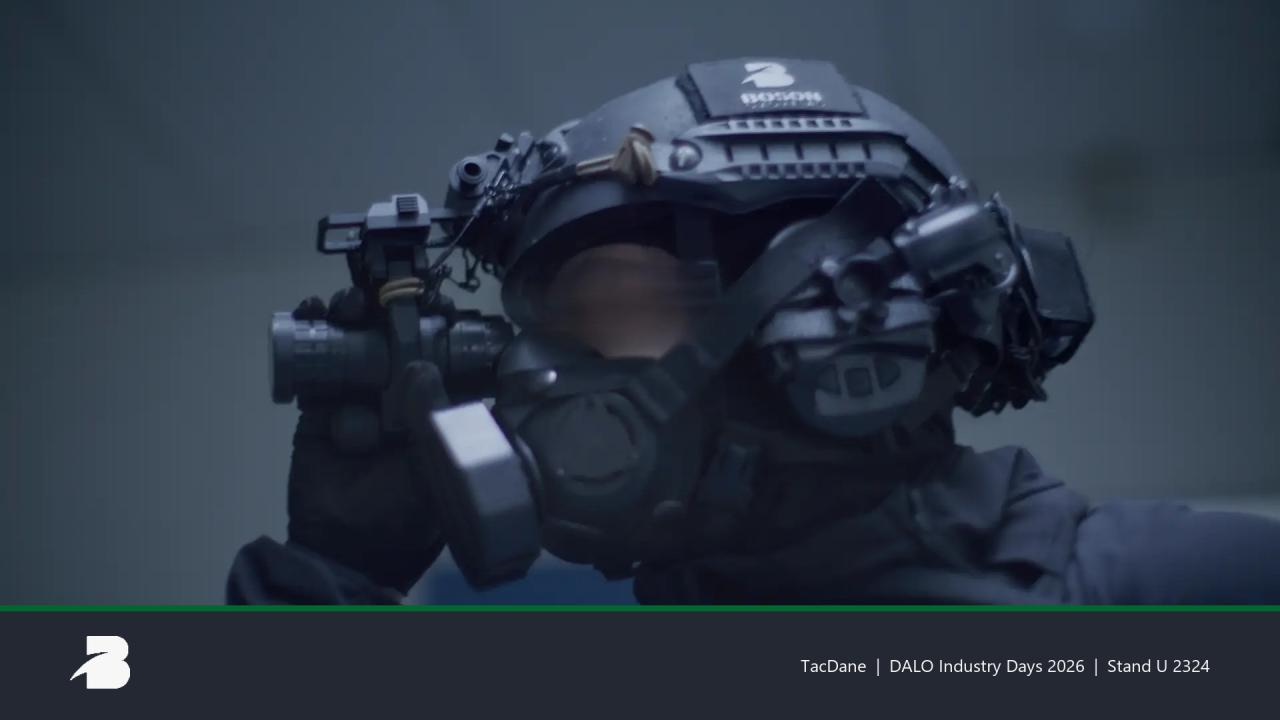
A helmet-mounted night vision goggle for military use is not a digital camera with a screen. That is not because the industry is behind. Analogue image intensification is the standard, and it is the standard for technical reasons that still hold.
An image intensifier tube has three parts. A photocathode converts faint light into electrons. A microchannel plate multiplies those electrons. A phosphor screen converts them back into visible light. The whole chain is optical and electrical with no image that has to be computed, so there is no delay between turning your head and the image following. A digital device has to read a sensor, process the signal and refresh a display. That delay is small, but it is there, and it is felt when moving fast in the dark.
The image is also continuous rather than divided into pixels, so there is no grid structure setting an upper limit on what can be resolved. Power draw is low enough that a unit runs a full day or more on a single small battery.
Digital has its own jobs. If the image has to be recorded, shared with others or fused with thermal, digital is the right choice. It is a different job, not a newer version of the same one.
Monocular or binocular is the next decision, and the misunderstanding here is widespread. The difference is not brightness, because each tube amplifies just as well whether one or two are fitted. The difference is depth perception. Two tubes give a sense of space, and that matters when judging distance, stepping over something or driving. A single tube is often worn over one eye so the other stays dark-adapted and can be used to read a map without being washed out.
Know the numbers on field of view before you compare. A classic monocular such as the PVS-14 has 40 degrees. A quad tube such as the GPNVG-18 has 97 degrees horizontal by 40 vertical, and that figure comes from L3Harris themselves.
Whether the phosphor is white or green is not a performance difference. Photonis, who manufacture tubes themselves, state no measurable difference in raw performance between the two. It is operator preference, and a number of users report less eye fatigue with white over a long shift.
Two things to watch for when reading a datasheet. First, there is no such thing as Gen 4. The designation was officially withdrawn in the United States, and where it appears today it covers tubes that are really Gen 2 or Gen 3. Second, FOM, resolution multiplied by signal-to-noise ratio, is a useful number that does not tell the whole story. Two tubes with the same FOM can behave very differently, because FOM does not capture halo around light sources, background noise or photocathode sensitivity. Never buy on FOM alone.
TacDane has Boson Systems at stand U 2324 on 19 and 20 August. Benjamin Alardin is attending from the manufacturer. Have the conversation about tubes and configuration with the unit in your hands.




This article is written by:
TacDane ApS
TacDane ApS supplies quality equipment to civilians, law enforcement, defense forces, and various organizations. We offer carefully selected firearms, ammunition, and tactical gear with a focus on reliability, functionality, and professional use.
Real Gear • Real Purpose