Cases
Signature is the whole kit, not just the goggle
arrow_backTo the overview28 July 2026 | TacDane ApS
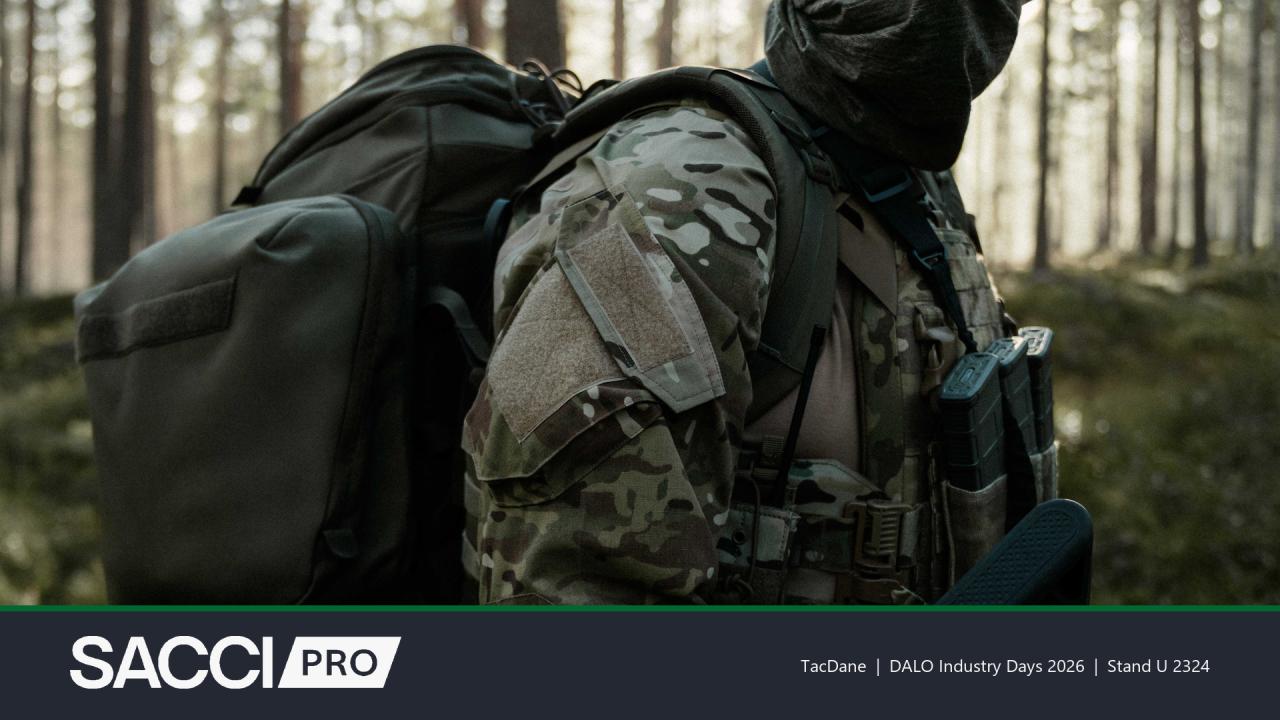
A night vision goggle solves half the problem. The other half is what the rest of the kit does when someone else looks through theirs.
An image intensifier tube works in the near-infrared band. Ordinary textiles, buckles and zippers can stand out from the surroundings in that band. The wearer is then clearly visible through a tube while remaining hidden from the naked eye. What colour a fabric is in daylight says nothing about how it looks through a tube.
That makes IRR treatment, also referred to as NIR compliant, a specification to ask for rather than assume. Sacci Pro's RAVIN range carries it on the outer fabric, the Herma buckles and the YKK zippers. The outer fabric is Cordura in 700D and 500D with DWR and PU coating.
At the other end of the problem sits the choice of goggle. Analogue image intensification is the standard in helmet-mounted military night vision, because there is no image to compute and therefore no delay between head movement and what you see. Boson Systems' Proton Lite is binocular with a 40 degree field of view and weighs 545 grams. That is the weight the neck carries on the helmet through a full night. The monocular Proton Lite-O weighs 270 grams. The difference between them is not brightness but depth perception: two tubes give depth in the image, one tube leaves the other eye dark-adapted. Image intensifier tubes are sold separately and chosen for the task. Photonis tubes from France can be specified.
Both ends of the problem are at TacDane's stand U 2324 on 19 and 20 August, where Benjamin Alardin from Boson Systems is on hand to answer questions on tube choice and mounting. Signature is hard to judge from a datasheet. Hold the equipment up in front of a tube and see for yourself.

This case is written by:
TacDane ApS
TacDane ApS supplies quality equipment to civilians, law enforcement, defense forces, and various organizations. We offer carefully selected firearms, ammunition, and tactical gear with a focus on reliability, functionality, and professional use.
Real Gear • Real Purpose
Meet us at DALO Industry Days