Cases
CLES-FACIL: Research of Safe Parachute Opening
arrow_backTo the overview15 July 2026 | Hottinger, Brüel & Kjær
Client description:
CLES-FACIL -- Lyon Space Experiment Club
Challenge:
The task of the 2011 rocket "Detrona" from CLES-FACIL was, amongst other things, to find out the force that the opening of a parachute exerts on a rocket. This value before now was only ever formally calculated and never actually measured. Therefore the exact knowledge of this value is of great importance to Rocket makers because: The opening of a parachute causes a "shock" to the Rocket, which, in this case, could cause irreparable damage to the complete Rocket construction.
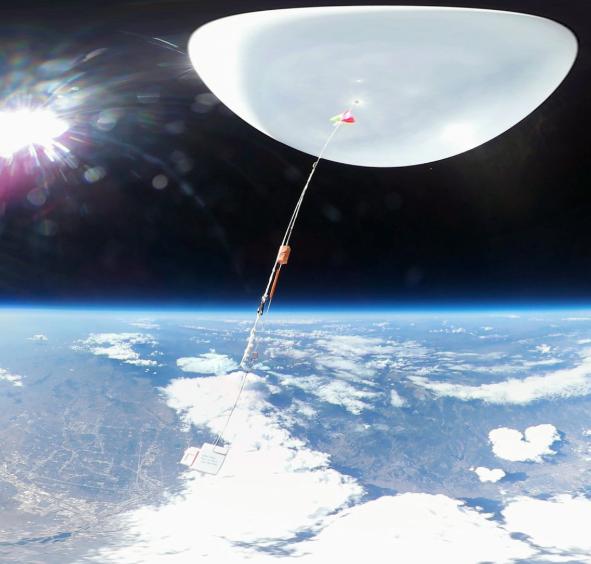
The Fusex Detrona is just short of 2 meters in length, with a diameter of 120mm and a weight of 10Kg. Parts of the rocket are transparent Polycarbonate in order for the installation of an on board camera to shoot 360°. In addition to this, a parachute is mounted, from which the force measurement will be taken.
Solution:
Altogether the force, upon the opening of a parachute, can be estimated through a semi-analytical formula: F=0,65*S*V2, whereby S represents the surface area of the parachute and V is the speed at the moment of opening. The speed of V can not be estimated and the size of the parachutes surface area really depends on the form that it opens in. Therefore the Team from CLES-FACIL decided to use HBK Strain Gauges to calculate the force of the Rocket Detrona.
The Strain Gauges were installed on the Parachute mounting in opposing directions, two in the direction of tension and two in the direction of compression. This layout allows Torsion and Strain flows to be blended out. In addition, there is an amplifier and a form of calculating software to record the measurement data.
Result:
The test flight, within which the Detrona Rocket was equipped with the strain gauges and telemetric system, was very successful. The Rocket reached a height of over 1000 meters. The opening of the parachute proved reliable and precise. Through the telemetric system the team collected all the relevant measurement data, and showed that the maximal force, which was exerted at the opening of the parachute, was 1210 Newtons.
The graph shows the development of force, which was measured during the Rocket flight. The different stages from the start of the flight to the expansion of the parachute are clearly identifiable.
The measured value from the flight helped the CLES-FACIL team in further developments and was also recognised in the field of aerospace. So much so that, due to the project Detrona, the CLES-FACIL won the first prize in the 2011 "Planète Sciences" C'Space competition for the third time. Moreover, a further prize was won the "Thalès Alenia Space" hosted by the French Air and Space-Travel association GIFAS.

This case is written by:
Hottinger, Brüel & Kjær
HBK (Hottinger Brüel & Kjær) provides advanced test, measurement and monitoring solutions for the defence, aerospace and industrial sectors. Our portfolio includes sensors, accelerometers, data acquisition systems, analysis software and calibration services for vibration, shock, acoustics, structural dynamics and environmental testing. HBK supports customers in verifying, validating and optimizing systems and components that must operate reliably in demanding environments.
See profileMeet us at DALO Industry Days